
What is sideshift?
Sideshift is a hydraulic side-shifting function on a forklift. It allows the operator to move the forks or fork carriage to the left and right without moving the entire forklift. This makes it easier to place pallets squarely into racks, trucks, or production lines.
In practice, the sideshift is one of the most commonly chosen options for forklifts. That’s because much of the work done with forklifts revolves around precise positioning. Think of pallets on racks, goods in a truck, pallets lined up in a row, or materials in a narrow production area.
Without a sideshift, the operator often has to move forward, reverse, and reposition the load several times to place the pallet correctly. With a sideshift, the operator can adjust the load a few centimeters to the left or right. As a result, the forklift operates faster, more smoothly, and often more safely.
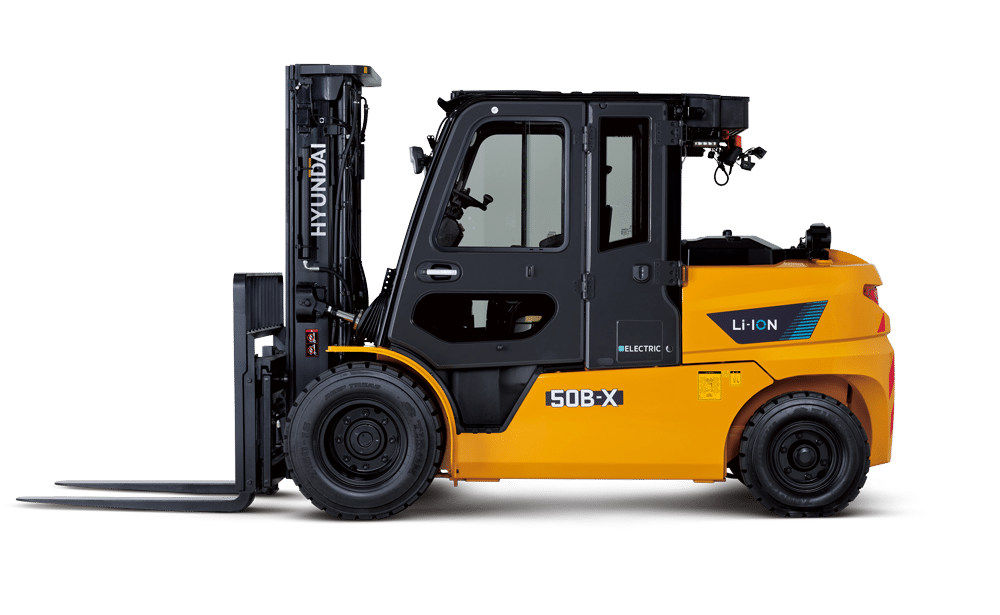
How does the sideshift function on a forklift?
The sideshift operates using a hydraulic cylinder. The operator controls the function using a hydraulic lever or joystick. The fork carriage or sideshift system then moves to the left or right.
The forks remain at the same height during this process. Only the position of the forks relative to the forklift changes. This allows the operator to align a pallet more precisely with a rack bay, loading dock, machine, truck side, or storage location.
The load is being picked up
The forklift picks up the pallet or load with the forks.
Driver corrects
The lever is used to move the load to the left or right.
Load is being placed
The pallet can be placed down more accurately and smoothly.
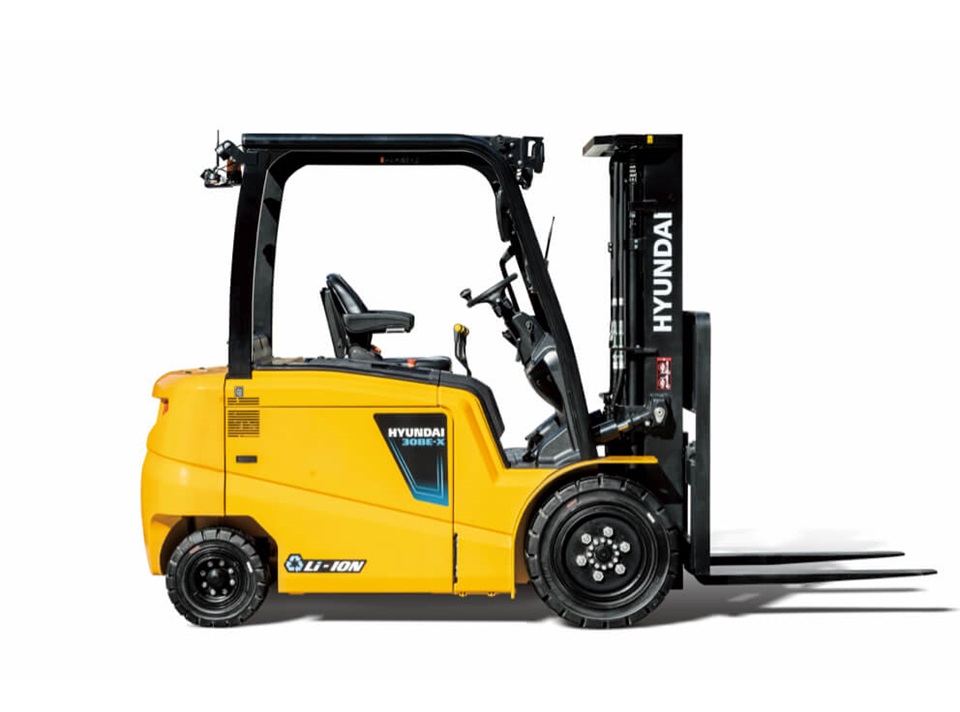
Sideshift on Hyundai BE-X models
For the Hyundai BE-X models, the side shift is often presented as a key standard feature. The 20BE-X is listed on heftruckkopen.com with side shift + 4 hydraulic functions. The 25BE-X and 35BE-X are listed with integrated side shift + 4 hydraulic functions.
Benefits of sideshift
Sideshift may seem like a minor feature, but it can make a big difference in day-to-day operations. This is especially true for companies where pallets are constantly being picked up, moved, and put away.
- Less maneuvering with the entire forklift
- Placing Pallets with Greater Precision
- Reduced risk of damage to shelving
- Work faster during loading and unloading
- Great for narrow hallways and tight spaces
- Fewer corrective maneuvers for the driver
- Better alignment in trucks and containers
- Working more calmly around machines and production lines
When is a sideshift useful?
Sideshift is particularly useful when precise positioning is important. In many warehouses and production environments, this is a daily requirement. The feature is therefore a popular choice for electric forklifts, but it can also be a valuable option for diesel and LPG forklifts.

Warehouse and logistics
In pallet racking, sideshift helps to place pallets straight into the bay. That prevents crooked placement and limits damage to racks, pallets, or goods.

Loading and Unloading
When working with trucks, trailers, and loading bays, the sideshift makes it easier to position pallets tightly next to each other without having to steer the forklift back and forth repeatedly.
Typical situations where sideshift is particularly beneficial
- Many pallet racks
- Loading and unloading of trucks
- Tight dispatch areas
- Narrow hallways
- Production lines with fixed stations
- Fragile goods or packaging
- Food, retail, logistics, and distribution
- Companies with a high volume of daily pallet movements
Does sideshift affect residual capacity?
Yes, a sideshift can affect a forklift’s residual capacity. This is because additional attachments add weight and sometimes shift the load slightly forward. As a result, the effective load on the forklift changes.
With an integrated sideshift, the impact is often more limited than with a retrofitted separate sideshift, but even then, the actual capacity must be carefully checked. This is especially important at high lifting heights, with heavy pallets, or long loads.
| Situation | Why pay attention? | Advice |
|---|---|---|
| Factory-integrated sideshift | Often more neatly integrated and tailored to the machine. | Please check the type plate and remaining capacity anyway. |
| Retrofit sideshift | Can add extra structural depth and weight. | Have capacity reassessed. |
| High lifting height | Capacity often decreases as the load is raised higher. | Check capacity at the actual lift height. |
| Heavy or long loads | The rear center of gravity can be further forward. | Use the load diagram and ask for advice. |
| Combination with fork positioner | More features can mean more weight and greater depth. | Always run a calculation for the entire configuration. |
Sideshift, fork positioner, and freelift: what's the difference?
Sideshift is sometimes confused with other functions on a forklift. Fork positioner and free lift, in particular, are frequently mentioned when specifying a new forklift. However, these functions each serve a different purpose.
| Function | What does it do? | When is this useful? |
|---|---|---|
| Sideshift | Moves the forks or the fork holder sideways to the left or right. | For precise pallet positioning. |
| fork adjuster | Hydraulically changes the distance between the forks. | When pallet widths vary or loads differ. |
| Freelift | Raise the forks without immediately raising the outer mast. | For containers, trailers, and low clearances. |
| Fork Extenders | Temporarily extend the forks. | For extended use, provided it is used safely and correctly. |
In many warehouses, sideshift is almost indispensable, while free lift is especially important when there are low height restrictions. A fork positioner is particularly useful when you handle many different pallet sizes or load widths.
What should you look for in a forklift with a sideshift?
When purchasing a forklift with a sideshift, it is important to consider the overall configuration. The sideshift must be compatible with the lift capacity, the mast, the fork length, the hydraulic functions, and the daily operations.
- Is the sideshift integrated or retrofitted?
- How much sideways movement is needed?
- Does the truck have enough hydraulic functions?
- What is the residual capacity with the sideshift?
- Is the attachment compatible with the mast and lift height?
- Is a fork adjuster also needed?
- How many pallet movements are there per day?
- Does the forklift operate in tight spaces?
When is a sideshift a smart choice?
Sideshift is particularly useful when the driver has to make frequent adjustments while positioning pallets. The more pallet movements per day, the faster the feature pays for itself through time savings, reduced damage, and a more pleasant working environment.
When is a sideshift alone not enough?
If you handle many different pallet widths, crates, or non-standard loads, a fork positioner in addition to sideshift may be more interesting. For low clearances or containers, freelift is precisely more important. With heavy attachments, the residual capacity must always be carefully assessed.
Would you like to know if your forklift needs a sideshift?
Heftruckkopen.com provides practical advice on sideshift, mast selection, hydraulic functions, fork length, residual capacity, and the right Hyundai forklift for your workplace. This way, you won’t just choose a standard forklift, but a machine that truly suits your daily operations.
Frequently Asked Questions About Sideshift
What is a sideshift on a forklift?
Sideshift is a hydraulic sideshift function that allows the forks or the fork carriage to move left and right without having to move the entire forklift.
What do you use a sideshift for?
Sideshift is used to position pallets more accurately in racking, trucks, containers, shipping areas, and production lines.
Is sideshift the same as a fork positioner?
No. Sideshift moves the forks sideways. A fork positioner changes the distance between the forks. Both functions can, however, be combined.
Does sideshift affect forklift capacity?
Yes, sideshift can affect the residual capacity because additional weight and construction depth influence the load on the forklift. Therefore, always check the capacity of the complete configuration.
Is sideshift useful in a warehouse?
Yes. In warehouses, sideshift is often very useful, because pallets need to be placed accurately in racks and there is often little room to constantly maneuver again.
Can sideshift be retrofitted?
That is often possible, but it must be technically compatible with the forklift, mast, hydraulics, and capacity. Always have the impact on residual capacity and safety checked.
When is an integrated sideshift better?
An integrated sideshift is often better tailored to the forklift and can have less impact on the installation depth than a separate retrofitted sideshift. The exact benefits depend on the machine and configuration.
 English
  Dutch
Dutch  German