When buying a forklift, many companies primarily look at the nominal lifting capacity on the nameplate. But in practice, the remaining capacity decisive. As soon as you lift higher, work with a different load center, or use attachments, there is often less actual capacity left than expected.
In this comprehensive guide, you will read how residual capacity works, which factors influence the actual lifting capacity, and what you need to look out for when buying a new or used forklift for your warehouse, production facility, shipping department, or heavier internal logistics.
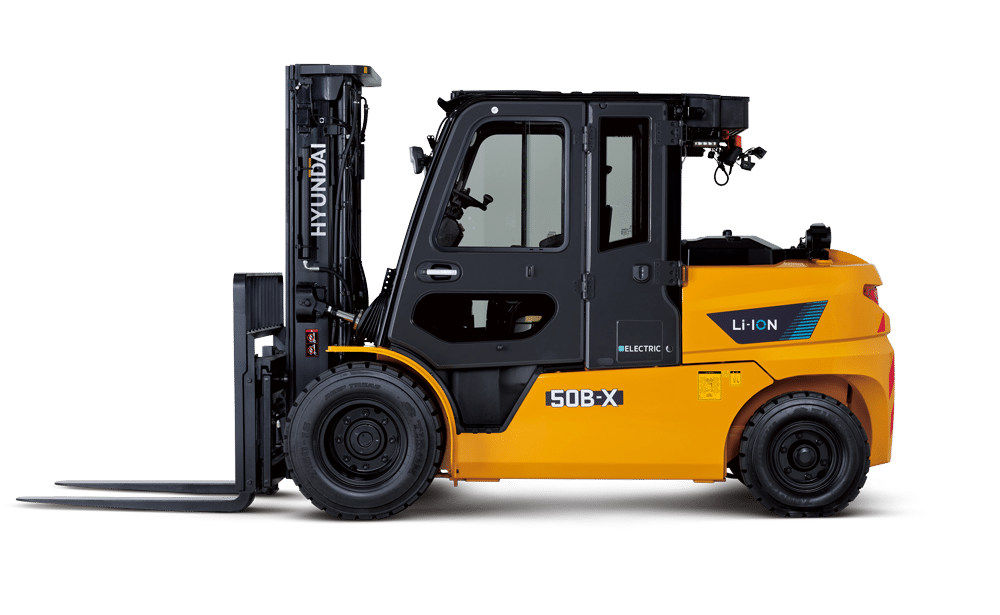
The remaining capacity is actual remaining lifting capacity under a specific operating condition. For example, a forklift may have a nominal capacity of 2,500 kg, but that does not automatically mean you can lift 2,500 kg at any height, with any load, and with every configuration.
The rated lifting capacity is typically specified under fixed reference conditions, such as a specific load center of gravity and a specific lift height. In practice, these conditions often change. Consider higher racking, heavier load centers, longer forks, a fork positioner, a paper clamp, a bale clamp, or another type of attachment. This brings you to the question that really matters: What remains in your situation?
When buying a forklift, it’s a good idea to consider not only the drive type and load capacity, but especially the combination of load center of gravity, lift height, mast, attachments, bucket length, and application. That exact combination determines whether a truck can be used safely and efficiently in practice.
The load center of gravity is the distance from the load’s center of gravity to the back of the forks. The farther forward the load is positioned, the greater the leverage on the forklift. As a result, the effective capacity decreases. This is an issue, for example, with long goods, non-standard pallets, crates, machines, or loads that protrude.
As you lift higher, the load on the mast and the forklift changes. As a result, the permissible capacity may decrease. A forklift that seems more than adequate at low heights may have less reserve capacity at higher lifting heights.
A duplex or triplex mast, free lift, mast construction, and overall lowered height all play a role in the final specification. Especially with higher warehouse racking or limited clearance height, this is an important part of the choice.
A sideshift, fork positioner, or clamp increases versatility, but also adds its own weight and often additional load center distance. As a result, the residual capacity may decrease. This is one of the reasons why two seemingly comparable forklifts can still have different capacities in practice.
Do you work with Euro pallets, block pallets, long goods, machine frames, or boxes? Then not only the weight is important, but also the way that weight is distributed. The further forward the center of gravity is, the more critical the specification becomes.
Although the type of tires does not directly determine the load capacity listed on the nameplate, stability, operating environment, and comfort do indeed affect how safely and practically you can operate the truck. Indoor floors, outdoor areas, thresholds, slopes, and uneven surfaces must therefore be taken into account in the recommendation.
The exact residual capacity is ultimately determined by the manufacturer or importer based on the truck, mast, load center of gravity, lift height, and any attachments. However, as a buyer or user, you can make a good initial estimate early on by gathering the right information.
You cannot reliably determine the remaining capacity with a single universal formula for all trucks, because manufacturer data, mast configuration, and attachments have a major influence. However, the basic rule is: the higher you lift and the further forward the load comes, the less capacity generally remains.
| Situation | Impact on residual capacity | Why This Is Important |
|---|---|---|
| Raise the tax rate | Often lower available capacity | The load on the mast and truck changes at greater heights |
| Center of gravity further forward | Capacity is decreasing | The leverage on the truck increases |
| Install a fork adjuster or clamp | Capacity often decreases | Additional weight and additional installation depth affect the design |
| Longer spoons or a longer load | More attention needed for the cost center | The center of gravity is often farther from the fork's spine |
| Different mast or higher platform | New capacity assessment required | A truck must be suited to the actual warehouse conditions |
That is why sound forklift advice is not simply a matter of choosing a specific tonnage, but rather a combination of the machine, the mast, the load, and the application.
Suppose you're looking for a 2.5-ton electric forklift for warehousing and shipping. On paper, that seems logical for pallets weighing up to 2,200 or 2,300 kg. But in practice, you may be working with taller racks, longer loads, or a fork positioner. In that case, there’s a good chance that the actual workload will exceed what the base configuration can handle.
That is precisely why it’s wise to look not only at the segment but also at the specific model. On heftruckkopen.com, for example, you’ll find popular Hyundai electric models such as the 20BE-X, 25BE-X, and 35BE-X, but the right recommendation depends on your load center, lift height, and options.

In such cases, it is sometimes wiser to look directly at a heavier-duty model, such as a heavier-duty electric truck or a diesel model designed for off-site use and heavy-duty handling.
Many purchasing mistakes aren't caused by the forklift itself, but by what is added to it later. Attachments make a forklift more functional, but they also alter the machine's technical balance. For example:
These options are often valuable for daily deployment, but do require a different capacity assessment. Do you primarily need advice on the choice between a sideshift and a fork positioner? Then also read our article about forklift with sideshift or fork positioner.
The correct residual capacity always depends on the application. That is why it is wise not to choose the truck in isolation, but in relation to your operating profile.
In warehouses and production areas, a electric forklift often the logical choice. Be sure to pay special attention to the turning radius, mast selection, lift height, loading strategy, and whether to choose a 3-wheel or 4-wheel model.
Does the truck need to drive outside a lot, work on rougher surfaces, or move heavy loads? Then a diesel forklift be more interesting, especially in heavy-duty applications and higher tonnages.
For businesses that want to refuel quickly and switch flexibly between indoor and outdoor operations, a LPG forklift be a practical solution.
Are you dealing with a seasonal peak, a project-based assignment, or a temporary capacity need? In that case, renting temporarily can sometimes be a smarter choice than buying right away. Be sure to check out the options at forkliftrental.com.
A forklift with an insufficiently high capacity is not only impractical, but can also lead to unsafe situations, workplace unrest, and unnecessary strain on both the machine and the operator. That is why it is important to carefully assess capacity, specifications, and intended use.
On the website of VA-keur You can read more about forklift inspections and which components are checked during the process. This is important for safe use, periodic inspections, and verifiable machine safety.
Are you buying a truck for heavy-duty use? If so, it’s a good idea to think ahead about maintenance, inspections, and certifications, so that the truck remains reliable not only today but also in the long term.
You don’t make the best purchasing decision based solely on the rated lifting capacity. The real question is how much capacity you’ll actually have left in your operation. Once lifting height, off-center load positions, bucket length, or attachments come into play, the actual performance may turn out differently than you initially anticipated.
That's why smart shoppers look at the big picture: load, height, mast, options, floor, operating hours, and future use. This will help you avoid undercapacity, unnecessary downtime, and additional costs down the road.
The rated capacity is the specified lifting capacity under standard conditions. The residual capacity is the lifting capacity that remains in practice given your actual load, lift height, mast, and any attachments.
Because the load shifts further forward. This creates more leverage on the truck, which affects its stability and its rated capacity.
Yes, that’s often the case. A fork positioner adds its own weight and overall depth, which can reduce the remaining capacity. Therefore, always specify any attachments in your request.
You can make an initial assessment by determining the load weight, load dimensions, lifting height, and attachments. A reliable result requires a custom design and technical evaluation.
Do not choose based on tonnage alone. Look at your pallets, height, mast, floor, operating hours, and any potential expansions. Sometimes a heavier or differently configured truck is ultimately the safer and more economical choice.
Certainly. With a used machine as well, the actual application must match the specification. Therefore, check not only the year of manufacture and operating hours, but also the mast, load center, and any available or desired attachments.
Send your pallet weight, dimensions, maximum lifting height and any attachments. Then we can look specifically at which Hyundai forklift suits your application — from compact electric models to heavier trucks for intensive work.

 English
  Dutch
Dutch  German