Often interesting for warehouses, dispatch, and work with a limited turning radius.
Strong choice for intensive use, higher load and mixed driving conditions.
Narrow aisles require something different than outdoor areas, heavy pallets, or longer driving distances.
The main difference lies in the construction and handling. A 3-wheel forklift is usually more compact and has a shorter runtime, which makes it easy to use in narrow hallways and tight spaces. A 4-wheel forklift actually provides greater stability, especially with heavier loads, higher speeds, or less-than-ideal flooring.
That doesn’t mean one is always better than the other. The right model depends on your application. Do you mainly work indoors and does every meter of turning radius count? Then a 3-wheel truck is often a good option. Are you looking for more stability and reliability when handling heavier loads? Then a 4-wheel forklift is often the logical choice.
That is why it is smart not to look solely at price or tonnage, but primarily at the workplace where the truck has to perform daily.

A 3-wheel forklift is particularly strong in environments where space is scarce. Think of warehouses, dispatch areas, production halls, and logistics spaces where a lot of steering, turning, and precise positioning is required.
Thanks to its compact design and small turning radius, a 3-wheel truck often feels lighter and more responsive to operate. This makes it attractive to companies that want to work quickly and efficiently in confined spaces.
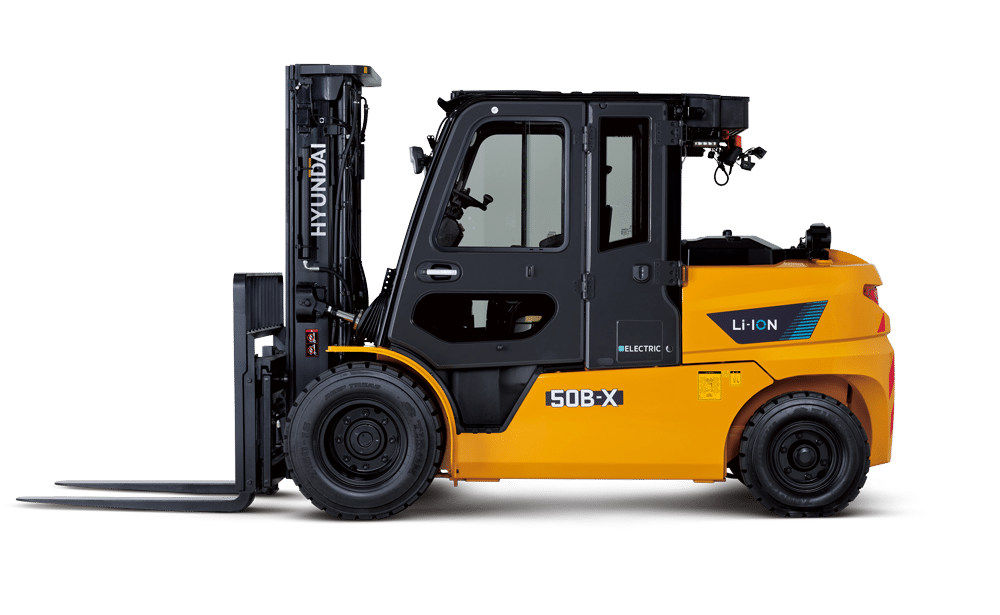
A 4-wheel forklift is often the better choice when stability, smooth operation, and versatility are more important than maximum compactness. This type of forklift generally feels more stable when handling heavier loads, traveling longer distances, and for mixed indoor and outdoor use.
For companies that operate under higher load capacities or are simply looking for a rugged, all-around machine, a four-wheeler is often the safest choice. Especially in manufacturing, industrial settings, outdoor areas, or when handling heavier pallets, this is often the preferred model.

For electric forklifts, this choice is particularly relevant. Many companies are looking for a machine that operates quietly, emission-free, and efficiently, while at the same time wanting sufficient maneuverability or, conversely, stability. Precisely for this reason, the operating environment is decisive.
A compact electric truck is often ideal for warehouse and production. A heavier 4-wheel electric forklift is better suited for higher loads, longer operating times, or applications where quietness and stability are important.
For this, please also view our pages on electric forklifts, de Hyundai 25BE-X and Hyundai 50B-X.
Bee diesel forklifts the focus is often on heavier outdoor applications, longer driving distances, and robust daily use. In that type of application, a 4-wheel version often makes sense, precisely because of its stability and broader applicability.
Bee LPG forklifts the consideration is often different. Flexibility between indoor and outdoor plays a larger role there. Even then, the choice between 3-wheel and 4-wheel still mainly depends on the turning circle, surface, and load.
Check out our categories as well diesel forklifts en LPG forklifts.
Don't base your decision solely on gut feeling or price. Be sure to consider these practical considerations:
In practice, the rule of thumb is: those who primarily drive indoors and have limited space are more likely to end up with a 3-wheel electric forklift. Those looking for more stability, doing heavier work, or driving outdoors more often choose a 4-wheel version.
Still, every situation remains different. A company with a narrow shipping department and regular heavier pallets has different requirements than a warehouse with light pallet flows or an industrial location with a rougher surface.
Therefore, we always advise based on your actual usage: load, space, lifting height, duration of use, floor type, and desired drive.
The choice between a 3-wheel or 4-wheel forklift ultimately comes down to the balance between maneuverability and stability. A 3-wheeler is often ideal in tight indoor spaces. A 4-wheeler is often stronger in terms of rest, security, and broader deployment.
Would you like to be sure which model best suits your company? Then we are happy to help you with a customized proposal, tailored to your floor, load, lifting height, and daily operations.
The biggest advantage is usually the maneuverability. A 3-wheel forklift is often very suitable for narrow aisles, tight warehouses, and a lot of steering in limited space.
A 4-wheel forklift is often smarter for heavier loads, higher operating hours, mixed indoor and outdoor use, and situations where stability outweighs maximum compactness.
Not necessarily, but in practice, a 3-wheeler comes into its own best in indoor environments where maneuverability is a major advantage.
That depends on your specific needs. For warehouses with limited space, a compact model is often a good choice. For heavier loads and greater stability, a 4-wheel electric forklift is often the better option.
Always provide your aisle width, load weight, lift height, type of floor surface, hours of operation, and the ratio of indoor to outdoor use. That way, you’ll receive much more tailored advice.
We are happy to advise you based on your work environment, load, aisle width, operating hours, and preferred drive type. This ensures you buy a forklift that truly works better in practice.


 English
  Dutch
Dutch  German