
How much does a new forklift cost? Explanation of price, options and version
Of price of a new forklift depends on much more than just brand or capacity. Drive type, mast, lift height, battery, cabin, tires, attachments, and service agreements together determine the final investment. Because manufacturers like Hyundai offer electric trucks, LPG models, diesel forklift trucks, and heavy-duty heavy line machines, prices naturally vary significantly per segment.
In this guide you will not only read how much a new forklift costs, but especially why price differences occur. This allows you to better compare quotes and prevents you from buying a machine that seems cheap on paper, but turns out to be more expensive in practice.
Contents of this guide
- Why do forklift prices vary so much?
- 1. Capacity determines a large part of the price
- 2. Drive: electric, diesel or LPG
- 3. Mast, lifting height, and free lift
- 4. Battery, charging, and energy selection
- 5. Cabin, tires and extra options
- 6. Attachments and custom-built equipment
- 7. Maintenance, inspection and total costs
- How do you compare quotes smartly?
- Frequently Asked Questions
Why do forklift prices vary so much?
The price of a new forklift varies because not every truck has to do the same job. A compact electric forklift for warehouse use requires a different build than a heavy diesel truck for outdoor work or an LPG forklift for mixed use. Hyundai shows on its European product site that the range varies from electric models to heavy-duty diesel “Heavy Line” trucks and LPG forklifts for various applications.
Because of this, comparing only the bare purchase price is misleading. A truck with a different mast, longer forks, a closed cabin, or a lithium-ion battery is not just more expensive—it is often also substantially differently equipped.
The main price factors
- lifting capacity and load center of gravity
- indoor or outdoor use
- type of drive
- mast configuration and lift height
- battery and charging solution
- attachments and comfort options
1. Capacity determines a large part of the price
One of the biggest price factors is capacity. The heavier the loads you want to move, the more robust the truck, mast, drivetrain, and body must be. You will see this reflected directly in the investment. For example, Hyundai shows separate product lines for standard trucks and for heavier heavy-line applications, including 12 to 16-ton diesel models for ports, logistics, and other heavy lifting environments.
The ratio between nominal capacity and actual deployment also matters. A 3-ton forklift that picks up standard pallets is different from a truck that has to work at greater heights, with a fork positioner, or with unusual loads. The more specific the deployment, the greater the chance that the price will increase due to additional configuration.
Light capacity
Often interesting for warehouses, logistics, and general pallet movement, with a relatively compact configuration.
Middle class
Popular for general indoor and outdoor use, but heavily dependent on the mast, tires, and optional extras.
Heavy capacity
Higher capacity generally requires heavier technology, larger components, and therefore a higher investment.
2. Drive: electric, diesel or LPG
The type of drive system also has a major influence on the new forklift price. Hyundai positions electric forklifts, diesel forklifts, and LPG forklifts each for different application profiles. On the official website, diesel is explicitly described as a robust choice for outdoor work, while LPG is positioned as an alternative to both diesel and electric for a wide range of applications.
Electric can turn out differently in purchase price due to battery technology and charging infrastructure. Diesel and LPG bring other choices regarding engine, fuel consumption, working environment and maintenance. As a result, you should not only look at the price tag, but at the overall suitability for your business.
| Drive | Price is heavily influenced by | Fits well with |
|---|---|---|
| Electric | Battery, charging strategy, deployment duration, options | Warehouse, Production, Material Handling |
| Diesel | Capacity, outdoor application, heavy components | Heavy-duty outdoor work and robust deployment |
| LPG | Performance, deployment profile, flexibility | Mixed use and repetitive loading/unloading processes |
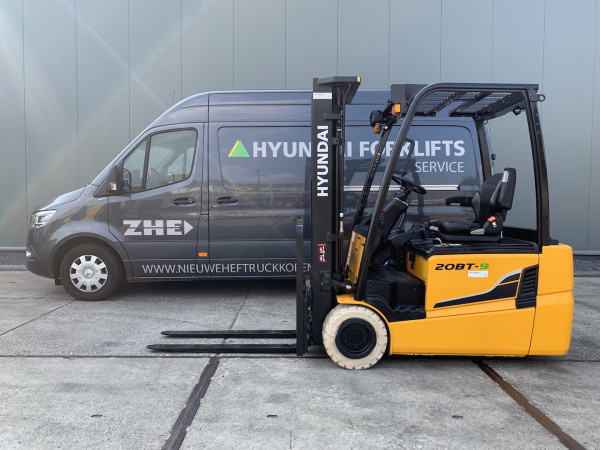

3. Mast, lifting height, and free lift
Two forklifts with the same capacity can still vary significantly in price depending on the mast. A different lift height, a triplex mast, free lift, or special clearance height directly affects the design and, therefore, the price. Especially in warehouses or for container handling, this is a much bigger price factor than many buyers anticipate.
If you compare quotes without looking closely at the mast configuration, you’re often comparing models that aren’t equivalent. As a result, one quote may seem cheaper, even though the machine is actually less suitable for the application.
Check every quote
- retracted mast height
- maximum lift height
- discretionary levy
- remaining capacity at altitude
- suitability for your racks, loading docks, or doorways
4. Battery, charging, and energy selection
With an electric forklift, the choice of power source has a major impact on the price. It’s not just the forklift itself that matters, but also the type of battery, the charging solution, and the usage profile. A machine designed for a single shift requires a different approach than a forklift that operates intensively or is used across multiple shifts.
Those who focus solely on the purchase price often underestimate how crucial the battery configuration and charging infrastructure are to the final investment. That’s why the quote must always be tailored to your actual operating time.
5. Cabin, tires and extra options
Many price differences stem from factors that may seem “minor” at first glance but are actually essential in practice. Think of a closed cab, heating, lighting, non-marking tires, additional hydraulic functions, a different seat, cameras, or safety features. These all affect the final price, but often also impact comfort, safety, and productivity.
As a result, the lowest bid is often the most basic option. That doesn't have to be a problem—as long as that option actually suits your needs.
6. Attachments and custom-built equipment
Attachments such as sideshift, fork positioners, special forks, extension forks, clamps, or other attachments can have a significant impact on the price. This is not only due to the additional cost of the attachment itself, but also because the forklift must be technically adapted to accommodate it.
This means that custom solutions are often more expensive, but may also be necessary to ensure the forklift is truly suited to your material flow. A standard forklift is cheaper, but it isn’t always the smartest investment.
7. Maintenance, inspection and total costs
The actual cost of a forklift doesn’t end with the purchase. Maintenance, tires, inspections, downtime, and parts all contribute to the truck’s long-term cost. VA-keur states that material handling equipment must be inspected periodically to ensure safety, legal compliance, and operational continuity, and explicitly cites the prevention of breakdowns, accidents, and high repair costs as a benefit. :contentReference[oaicite:6]{index=6}
Therefore, a competitively priced machine without good service or proper inspection is not automatically more affordable. Anyone who seriously looks at the total cost always takes service and maintenance into account in their consideration.
Price as stated in the quote
- basic model
- Selected mast and forks
- battery or drive system
- Cab and Options
Price in Practice
- Maintenance and Parts
- Inspection and Safety
- Downtime and Availability
- residual value and useful life
What's the smart way to compare quotes for a new forklift?
Never compare quotes based solely on the total price. Always check to see if the specifications are truly the same. For example, a cheaper quote might include a simpler mast, a lighter battery, an open cab, or less extensive hydraulic preparation.
Always check
- capacity and center of gravity
- mast and lift height
- battery or fuel-powered version
- tires, forks, and hydraulic functions
- Service, Warranty, and Delivery Standards
A Smart Next Step
- Have your deployment profile assessed in advance
- Request a customized solution, not a standard price
- Compare total costs rather than just the purchase price
- also include rent or lease in the consideration
 English
  Dutch
Dutch  German